Do You Need a Permit for a Panel Upgrade in Vermont?
Last Updated: November 9, 2026
Quick Summary
Yes, in most cases you need a panel upgrade permit, because replacing or upgrading a main electrical panel changes the service feeding your whole home. Most local building departments require a permit and at least one inspection before the job is closed. Check with your town or city building department early, since requirements vary by jurisdiction.
Looking for this work in Rutland or central Vermont? See panel upgrades in Vermont from Precision Power Services.
- Plan on a permit if the work changes panel amperage, moves the service, or adds new circuits.
- Small fixes like swapping one outlet or a breaker in an existing panel often fall outside the requirement.
- A licensed electrician usually pulls the permit and schedules the inspections.
- Energizing the new panel before inspection can void the permit and trigger a re-inspection fee.
- Keep the closed-permit record and final sign-off with your home documents, since insurers may ask for them.
Table of Contents
- Why Most Panel Upgrades Require a Permit
- Electrical Panel Replacement Permit Requirements Explained
- Who Pulls the Permit: Homeowner or Licensed Electrician
- Step-by-Step: How to Pull a Panel Upgrade Permit
- Electrical Panel Upgrade Permit Cost and What Affects It
- How Long Panel Replacement Takes, Inspection Included
- Do You Need a Permit to Add a Subpanel?
- Schedule Your Panel Upgrade with a Licensed Vermont Electrician
- Frequently Asked Questions
Why Most Panel Upgrades Require a Permit
Yes, in most cases you do need a permit for a panel upgrade. Replacing or upgrading a main electrical panel changes the service that feeds your whole home or building, so it is treated as significant electrical work.
For homeowners, the short answer: if the work changes the panel's amperage, moves the service, or adds new circuits, plan on a permit.
What Triggers the Permit Requirement
Not every electrical repair needs a permit, but a panel upgrade almost always does. Work that typically triggers the requirement includes:
- Replacing a main panel with a higher amperage service, such as going from 100 amps to 200 amps
- Relocating the panel or the service entrance
- Changing the service disconnect or grounding system
Small fixes like swapping a single outlet or replacing a breaker in an existing panel often fall outside the permit requirement. Check with your local building department before assuming a job is exempt.
The Role of the Local Building Department
Your town or city building department enforces the electrical code for your property, reviewing applications, scheduling inspections, and confirming the finished work meets code. Local jurisdictions manage permits and inspections, so requirements vary from town to town.
Contact your local office early. Ask whether a panel replacement needs a permit, what documents they require, and how long reviews usually take.
Electrical Panel Replacement Permit Requirements Explained
Most jurisdictions require a permit for a panel replacement because the new panel must meet current code. The permit makes sure the load calculation, grounding and bonding, and breaker sizing all match the new service.
Expect the permit application to ask for:
- The existing and proposed service size in amps
- A load calculation showing the home's expected electrical demand
- The panel make, model, and rating
Many areas also require a separate permit for utility disconnection and reconnection, since the power company must cut service during the swap. Confirm this with both your building department and your utility.
Who Pulls the Permit: Homeowner or Licensed Electrician
Many jurisdictions expect a licensed electrician to perform and permit panel work. Some allow an owner-builder permit for a homeowner's primary residence, but the work still must pass inspection.
For most homeowners, hiring a licensed electrician is the safer and faster route. A licensed electrician typically handles the permit and inspection scheduling. Ask any contractor who will pull the permit and who will be on site for the inspection before you sign.
Step-by-Step: How to Pull a Panel Upgrade Permit
Most guides describe the permit process in the abstract. Here is the practical version that gets a panel upgrade permitted without a month of back-and-forth.
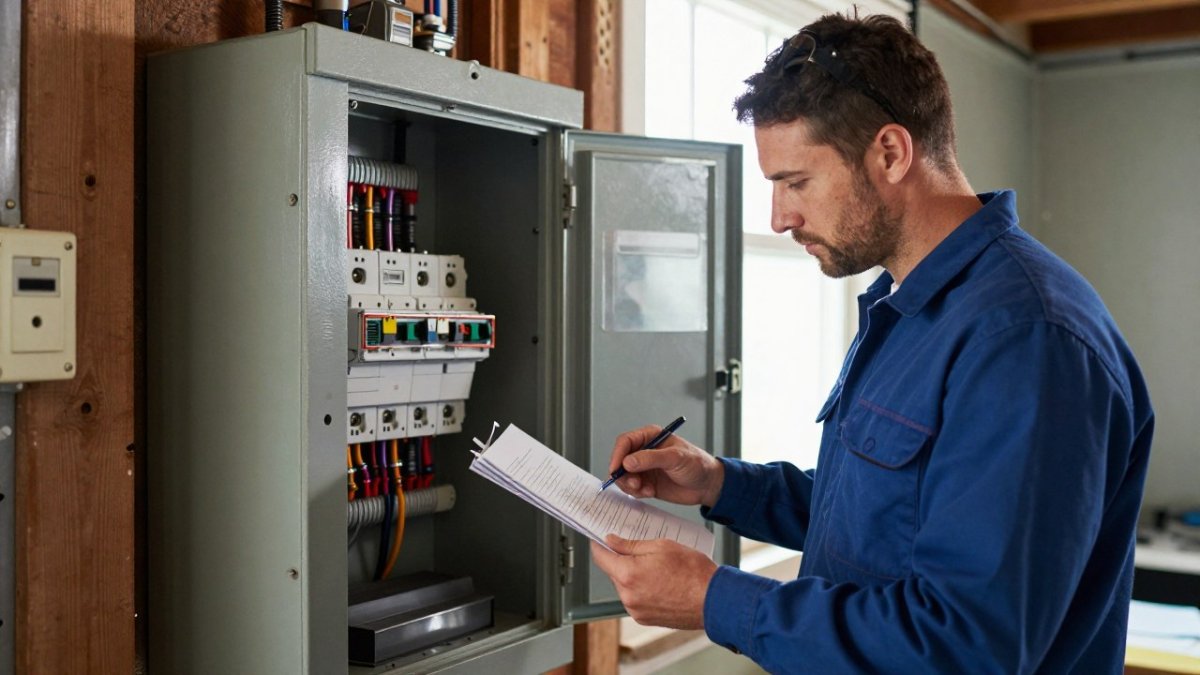
- Confirm the requirement and the review path. Call or email your local building department with the exact work: existing and proposed amperage, whether the service entrance moves, and whether the utility must disconnect. Ask whether a panel upgrade is handled over-the-counter or requires plan review, over-the-counter permits can often be issued the same day; plan review adds days to weeks.
- Find the permit portal before you find the forms. Most departments run an online permitting portal (often Accela, Tyler, or a state-run system). Search your town's website for "online permitting" or "electrical permit application." If there is no portal, the application is usually a PDF plus in-person or mail submission. Save the fee schedule PDF, it is the only authoritative cost source.
- Assemble the submittal package. Expect to provide the existing and proposed service size in amps, a load calculation, the panel make/model/rating, a simple site or riser diagram, the licensed electrician's name and license number, and the property owner's authorization if the contractor is pulling the permit. Missing one item is the most common cause of a rejected submittal.
- Submit and pay. Many portals take payment at submission; some invoice at issuance. Keep the receipt and application number for inspection scheduling.
- Track plan review. Check the portal status rather than calling daily. Reviewers commonly issue comments (for example, asking for a clearer grounding detail or a corrected load calculation); respond in the portal so the thread stays attached to the permit.
- Schedule the rough-in inspection. This happens after the panel is set and wiring is run but before the walls are closed and before the new panel is energized. The inspector wants to see grounding and bonding, conductor sizing, and breaker placement.
- Schedule the final inspection. The final covers labeling, breaker sizing, GFCI/AFCI requirements, and the completed grounding electrode system. Get the sign-off in writing or download the inspection record from the portal.
- Close the permit and archive the file. A permit is not closed until the final inspection passes and the department records it. Download the closed-permit record and file it with your closing documents.
Watch out: Energizing the new panel before the rough-in or final inspection can void the permit and force a re-inspection fee, confirm with your electrician that the panel stays de-energized until the inspector signs off.
Who Should Actually Pull the Permit
In most jurisdictions a licensed electrician pulls the permit, and it is issued in the contractor's name, meaning the contractor, not you, carries responsibility for code compliance and for showing up to inspections. Some jurisdictions allow a homeowner to pull an owner-builder permit for their own primary residence, but the work must still pass the same inspections. For most homeowners the licensed route is faster, safer, and cheaper once you price in the risk.
What the Inspector Actually Checks
Knowing the inspection checklist in advance is the best way to pass on the first visit. Inspectors commonly verify: the service disconnect rating matches the panel, the grounding electrode conductor is correctly sized and bonded, neutral and ground are separated in a subpanel but bonded only at the service, breaker sizes match conductor ampacities, AFCI/GFCI protection is present where the code edition in force requires it, and the panel directory is legibly filled out.
The Modern-Load Angle
A panel upgrade is increasingly the first step in a larger electrification project, and the permit scope should reflect that. If you are adding a Level 2 EV charger, rooftop solar, battery storage, or a heat pump, tell the building department at application time.
The permit process breaks down into a few steps, each with a practical check you can run before submitting.
| Step | What to do | Time or frequency |
|---|---|---|
| Confirm the requirement | Call or email the building department with the exact work | Before any work starts |
| Assemble the submittal package | Include service amps, load calculation, panel rating, electrician's name | Missing one item is the most common rejection |
| Schedule rough-in inspection | Inspect grounding, bonding, conductor sizing before walls close | Before panel is energized |
| Schedule final inspection | Covers labeling, breaker sizing, GFCI/AFCI, grounding electrode | Get sign-off in writing or download record |
| Close the permit | Download closed-permit record and file with closing documents | Only after final inspection passes |
Electrical Panel Upgrade Permit Cost and What Affects It
Permit fees for a residential panel upgrade vary by jurisdiction and project scope.
Check your building department's current fee schedule for the figures that apply to your project.
What actually moves the permit fee:
- Service size. A 200-amp service generally costs more to permit than a like-for-like 100-amp replacement, because the declared value and the inspection scope are larger.
- Scope of work. A straight panel swap with no service change is cheaper to permit than a service upgrade that includes a new meter base, mast, grounding electrode system, and utility coordination.
- Separate permits. Many jurisdictions require a separate permit for the utility disconnect/reconnect, and some charge separately for the rough-in and final inspections.
Permit fees are only one line in the total project cost.
Watch out: A bid that is dramatically lower than the others often excludes the permit fee, the utility coordination, or the inspection re-fee, confirm in writing who pays each line before you sign.
The Insurance Angle Most Guides Skip
Permit cost is easy to compare; the insurance consequence of skipping the permit is not. If unpermitted electrical work later causes a fire or shock injury, a homeowners policy claim can be contested on the grounds that the work was never inspected and the loss stems from non-compliant work. Insurers may contest a claim tied to unpermitted work, shifting the burden to the homeowner to show the work was done correctly.
Post-Inspection Documentation Checklist
Keep these records together, they are what a future buyer's inspector, your insurer, and your own memory will ask for:
- The approved permit number and the final inspection sign-off (the signed card or the online inspection record)
- The load calculation submitted with the application
- The panel manufacturer's spec sheet and the breaker schedule
Store digital copies in the same place you keep your deed and insurance policy. When you sell, this packet is the difference between a clean disclosure and a price concession.
How Long Panel Replacement Takes, Inspection Included
The full timeline including permit review and inspections usually runs longer than the on-site work. Plan for the permit review period plus inspection windows.
Projects requiring a utility disconnect or service upgrade take longer, since the utility must coordinate the shutoff. Build that time into your plans, especially if you need the power for a heat pump or EV charger installation.
Do You Need a Permit to Add a Subpanel?
In most cases, yes. A subpanel adds new circuits and draws power from the main panel, so it is treated as new electrical work. Local rules vary, but expect to need a permit and an inspection for a subpanel installation.
Before adding a subpanel, have a licensed electrician check whether your existing main panel has enough capacity. A load calculation shows whether the service can support the added circuits safely.
Schedule Your Panel Upgrade with a Licensed Vermont Electrician
Panel upgrades involve permits, inspections, and code requirements that are easy to get wrong on your own. Precision Power Services is a Vermont licensed electrician with 7 years of experience and more than 500 completed projects across Rutland and central Vermont.
Ready to move forward? Book your panel upgrade online with Precision Power Services.
Older panels in Vermont homes
Many Vermont farmhouses and older homes in towns like Rutland, Proctor, and Brandon still have original 60- or 100-amp service, fuses, or panel brands that are no longer made. If you are adding a heat pump, EV charger, or addition, the panel is usually the first thing to check.
Electrical work in Vermont follows the National Electrical Code as adopted in the Vermont Electrical Safety Rules (2025 edition, enforced by the Division of Fire Safety). Precision Power Services is a Vermont licensed electrician based at 450 Park Ln in Rutland, serving Rutland County and central Vermont.
Book a free estimate or call (802) 417-0587.
Frequently Asked Questions
Can I install a subpanel without a permit?
In most US jurisdictions, adding a subpanel counts as new electrical work and requires a permit, even if the main panel is unchanged. The subpanel feeds additional circuits, so the local building department typically wants to verify the load calculation, grounding and bonding, and the feeder wire size. Skipping the permit can cause problems with insurance claims and home sales. Check with your local building department before starting, since requirements vary by town.
Can I do my own electrical panel upgrade?
Many jurisdictions allow homeowners to pull a permit and do their own electrical work on the home they own and live in. Owner-builder rules differ by location, and some areas restrict service entrance work to licensed electricians. Even where it is allowed, the work must pass inspection. A licensed electrician can typically handle the permit, the utility coordination and the inspection.
How much does a permit to upgrade an electrical panel cost?
Permit fees are set by each local building department and are usually calculated from the project scope or the service amperage. Pricing depends on your jurisdiction, the size of the upgrade and whether a subpanel is included, so there is no single figure that applies everywhere. Contact your local building department for the current fee schedule, or request a quote from Precision Power Services for current pricing.
What happens if I upgrade an electrical panel without a permit?
Unpermitted work can lead to failed home inspections during a sale, required removal or re-inspection, and fines. Insurers may deny or reduce a claim if a fire traces back to unpermitted electrical work. Because the work was never inspected, any defects in grounding, bonding or breaker sizing remain hidden. Pulling the permit after the fact is often more costly and sometimes requires opening finished walls.
Need an electrician in Rutland or central Vermont?
Precision Power Services is a licensed and insured electrical contractor serving Rutland, Killington, Brandon, Castleton, and surrounding towns. Call (802) 417-0587 or book online.
← Back to blog