7 Factors That Set Your 2026 Panel Upgrade Cost
Last Updated: October 30, 2026
Quick Summary
The panel upgrade cost depends on amperage, the condition of the existing service, the meter and service entrance, permit fees, and any extra work the house needs. A 100-amp to 200-amp upgrade is usually quoted at $2,500 to $6,000, while a 200-amp to 400-amp upgrade often runs $6,000 to $15,000 or more.
Looking for this work in Rutland or central Vermont? See panel upgrades in Vermont from Precision Power Services.
- Amperage is the biggest driver, and 400-amp work often requires utility coordination.
- Confirm in writing whether the quote includes the meter base, service entrance conductors, and grounding corrections.
- A licensed electrician should pull the permit, since inspection protects resale, insurance, and warranty coverage.
- Utility disconnect and inspection scheduling are the most common causes of project delays.
- Ask for an itemized quote with permit fees and inspection listed as separate lines.
Table of Contents
- Panel Replacement Versus Panel Upgrade: What Changes the Price
- What a 200 Amp Panel Upgrade Cost Covers
- Cost by Amperage: 100-Amp to 200-Amp and 200-Amp to 400-Amp Projects
- Permits, Inspections and the Electrical Panel Upgrade Permit Cost
- How Long an Electrical Panel Upgrade Takes, Start to Finish
- Signs You Need an Electrical Panel Upgrade Before Adding a Heat Pump or EV Charger
- Getting an Itemized Quote for Your Panel Upgrade
- Frequently Asked Questions
Most homeowners asking about the residential panel upgrade cost in 2026 want one number, and a single number is hard to give honestly. Precision Power Services, a Vermont licensed electrician team serving Rutland and central Vermont, works through this question on every estimate we write. The price depends on amperage, the condition of the existing service, the meter and service entrance, permit fees, and whether the house needs anything beyond the panel itself.
We do not publish a flat price here because a fair figure requires a site visit. Instead, this guide lays out what drives the cost so you can read a quote with confidence.
Panel Replacement Versus Panel Upgrade: What Changes the Price
A panel replacement swaps an old panel for a new one at the same amperage. A panel upgrade increases service capacity, for example moving from 100 amps to 200 amps. The second job almost always costs more because it touches the service entrance, the meter base, and often the grounding system.
The distinction matters when you compare quotes. One contractor may price a same-amperage swap while another prices a full service upgrade, and the numbers will not line up. Ask each provider to define the project scope in writing before you compare totals.
What a 200 Amp Panel Upgrade Cost Covers
A typical 200-amp upgrade includes the new panel and main breaker, labor, service entrance conductors where required, and a new meter base if the existing one cannot be reused. Many quotes also include grounding and bonding corrections, surge protection, and rerouting or relabeling circuits.
Precision Power Services provides itemized estimates so you can see exactly what each line covers. You can request a panel upgrade estimate for a specific scope of work in Vermont.
Cost by Amperage: 100-Amp to 200-Amp and 200-Amp to 400-Amp Projects
Amperage is the single biggest driver of price, but the number on a quote only means something once you know what scope sits behind it. Three scopes get quoted under the same "panel upgrade" label, and they are not interchangeable:
- Panel-only replacement (same amperage). New panel and main breaker, branch circuits re-terminated, no change to the service entrance, meter base, or service drop. This is the cheapest scope and the one most often quoted as a headline price.
- Amperage increase (most commonly 100 amps to 200 amps). New 200-amp panel, new 200-amp main breaker, new service entrance conductors, and usually a new meter base and grounding/bonding corrections. This is the scope most homeowners actually need when adding a heat pump, EV charger, or electric range.
- Full service upgrade (200 amps to 400 amps). Everything above plus a larger service entrance, often a new meter enclosure, and utility coordination for a heavier service drop or transformer review. This is the scope that produces the scary numbers, and it is rarely apples-to-apples with the first two.
Typical ranges by scope
| Scope | Typical all-in range | What is usually included | What is often excluded |
|---|---|---|---|
| Same-amperage panel replacement (100A or 200A) | $1,500-$3,500 | Panel, main breaker, labor, basic labeling | Permit fee, meter base, service entrance conductors, grounding corrections |
| 100A to 200A upgrade | $2,500-$6,000 | 200A panel, main breaker, service entrance conductors, meter base, grounding/bonding, permit | Utility disconnect/reconnect fees, drywall or siding repair, circuit additions |
| 200A to 400A upgrade | $6,000-$15,000+ | 400A panel and main, larger service entrance, meter enclosure, utility coordination | Transformer upgrades (utility-side), trenching, long service runs, structural work |
Why 400-amp work costs disproportionately more
The jump from 100 to 200 amps is mostly a panel-and-conductors job. The jump from 200 to 400 amps usually crosses into utility territory: the service drop may need to be heavier, the meter enclosure may need to be larger, and the utility may need to review whether the existing transformer can carry the added load. That review is outside the electrician's control and outside the electrician's price, which is why 400-amp quotes often carry allowances and contingencies rather than firm totals.
What actually pushes a job from the low end to the high end
- Service entrance conductors. If the existing conductors cannot carry the new amperage, they get replaced, often the largest single line item after the panel itself.
- Meter base condition. A reusable meter base saves money; a corroded or undersized one does not.
- Grounding and bonding. Older services frequently fail this on inspection, and correcting it is code-required work, not optional.
- Utility disconnect and reconnect. Some utilities charge for the disconnect and the reconnect, and some require the electrician to schedule both.
- Circuit additions. A panel upgrade does not include new circuits. Adding a dedicated EV charger circuit or a heat pump circuit is priced separately.
Precision Power Services itemizes each of these line items in a written quote so you can see which scope you are actually being quoted.
Permits, Inspections and the Electrical Panel Upgrade Permit Cost
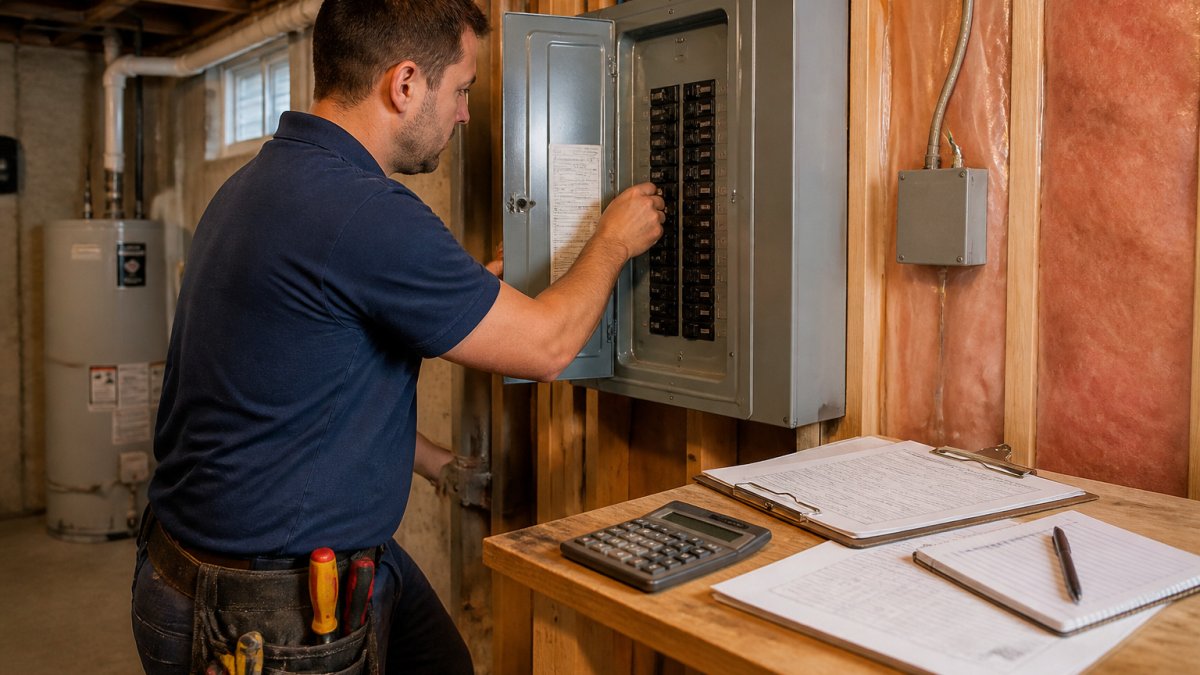
A service upgrade is permitted work in nearly every jurisdiction, and the permit is not paperwork, it is the mechanism that gets the installation inspected and creates a record that survives a home sale or an insurance claim. Understanding how the permit and inspection sequence works is the difference between a quote that is complete and one that grows after the contract is signed.
What the permit actually covers
A residential service permit typically covers the panel, the main breaker, the service entrance conductors, the meter base, and the grounding and bonding. It generally does not cover new branch circuits added at the same time (an EV charger circuit, a heat pump circuit, a hot tub), those are usually permitted as separate items or added to the same permit as additional scope. Ask the contractor which circuits are on the permit and which are not.
Who pulls the permit, and why it matters
A licensed electrician should pull the permit in their own name. When a homeowner pulls an owner-builder permit, the inspection still happens, but the warranty and liability picture changes, and some insurers and buyers treat owner-pulled electrical permits differently. If a contractor asks you to pull the permit, that is a signal to ask why.
The inspection sequence
Most service upgrades follow the same rough sequence:
- Permit application and approval. The permit is filed, fees are paid, and the jurisdiction issues the permit, often same-day or within a few business days, but slower in jurisdictions with heavy backlogs.
- Utility disconnect. The utility disconnects power at the meter so the service can be worked on safely. Some utilities schedule this days out; a few require the electrician to coordinate a specific window.
- Rough-in and panel installation. The panel, service entrance, meter base, and grounding are installed and the work is left ready for inspection.
- Inspection. The inspector reviews the panel, grounding and bonding, conductor sizing, and clearances. A failed inspection means corrections and a re-inspection, which adds time and sometimes a re-inspection fee.
- Utility reconnect. After the inspection passes, the utility reconnects and the meter is sealed.
What the permit and inspection cost
Permit fees are set by the local jurisdiction. Permit fees are set by the local jurisdiction, and the exact amount for your project should appear as its own line on your written quote.
Ask the contractor to show the permit fee as its own line item and to confirm whether the inspection visit is included.
Why permitted work protects you later
- Sale and appraisal. An unpermitted service upgrade can surface during a buyer's inspection and stall a closing.
- Insurance. A claim tied to an unpermitted panel can become a coverage dispute.
- Warranty. Most manufacturer warranties and contractor workmanship warranties assume the work was inspected.
A licensed electrician should pull the permit, schedule the inspection, and hand you the signed-off inspection record at the end of the job.
How Long an Electrical Panel Upgrade Takes, Start to Finish
The timeline grows when the utility must disconnect power, replace the meter, or upgrade the service drop. Permit approval and inspection scheduling can add days or weeks before and after the physical work.
Plan for the utility coordination early. Delays there are the most common reason a project runs longer than the quote suggests.
Signs You Need an Electrical Panel Upgrade Before Adding a Heat Pump or EV Charger
Watch for flickering lights when large appliances start, breakers that trip under normal use, a panel that feels warm, or a panel brand known for failures. To check your own panel step by step, see how to identify outdated electrical panels. If you plan to add a heat pump or an EV charger, have a load calculation done first. Adding those loads to an undersized panel is one of the most common reasons homeowners need an upgrade sooner than expected.
Getting an Itemized Quote for Your Panel Upgrade
A useful quote lists the panel size, the breaker, the meter work, permit fees, inspection, labor, and any utility charges separately. Be cautious of a single lump-sum number with no breakdown, since it becomes hard to compare with other bids.
Verify that the electrician holds a Vermont license and carries liability insurance. Ask whether they handle the permit and utility coordination themselves. Those details often matter more than the bottom-line price.
For a quote specific to your home, schedule a site visit with Precision Power Services or book online.
Older panels in Vermont homes
Many Vermont farmhouses and older homes in towns like Rutland, Proctor, and Brandon still have original 60- or 100-amp service, fuses, or panel brands that are no longer made. If you are adding a heat pump, EV charger, or addition, the panel is usually the first thing to check.
Electrical work in Vermont follows the National Electrical Code as adopted in the Vermont Electrical Safety Rules (2025 edition, enforced by the Division of Fire Safety). Precision Power Services is a Vermont licensed electrician based at 450 Park Ln in Rutland, serving Rutland County and central Vermont.
Book a free estimate or call (802) 417-0587.
Frequently Asked Questions
How much does it cost to upgrade a residential electrical panel in 2026?
Costs vary with amperage, labor rates, materials, permits and site conditions, so no single figure applies to every home. Precision Power Services does not publish a fixed price list. A straightforward same-amperage replacement is usually priced differently from a full service upgrade that includes a new meter base or overhead service. The most reliable way to get your number is a site visit followed by a written, itemized quote that lists labor, materials, permit fees and any add-on work. Contact Precision Power Services or book online for a quote specific to your home.
How much does it cost to upgrade to a 200-amp electrical panel?
A 200 amp panel upgrade cost depends mainly on whether the existing service is 100 amps or lower, whether the service entrance and meter need changes, and how much wiring must be updated to match the new capacity. Homes with heat pumps or EV chargers often need the extra capacity. Because every property has different conditions, the price depends on inspecting your home first. Request a quote to see what a 200-amp upgrade would involve for your specific house.
Do I need a permit to upgrade my electrical panel?
In most cases, yes. Panel upgrades are typically permitted work because they affect the safety of the entire electrical system. Permit requirements and fees are set by the local building department, so the exact cost varies by town. An inspection is normally required after the work is complete. Ask the contractor to show the permit fee as a separate line on your itemized quote.
Need an electrician in Rutland or central Vermont?
Precision Power Services is a licensed and insured electrical contractor serving Rutland, Killington, Brandon, Castleton, and surrounding towns. Call (802) 417-0587 or book online.
← Back to blog