Commercial Electrical Maintenance for Businesses: A Complete Guide
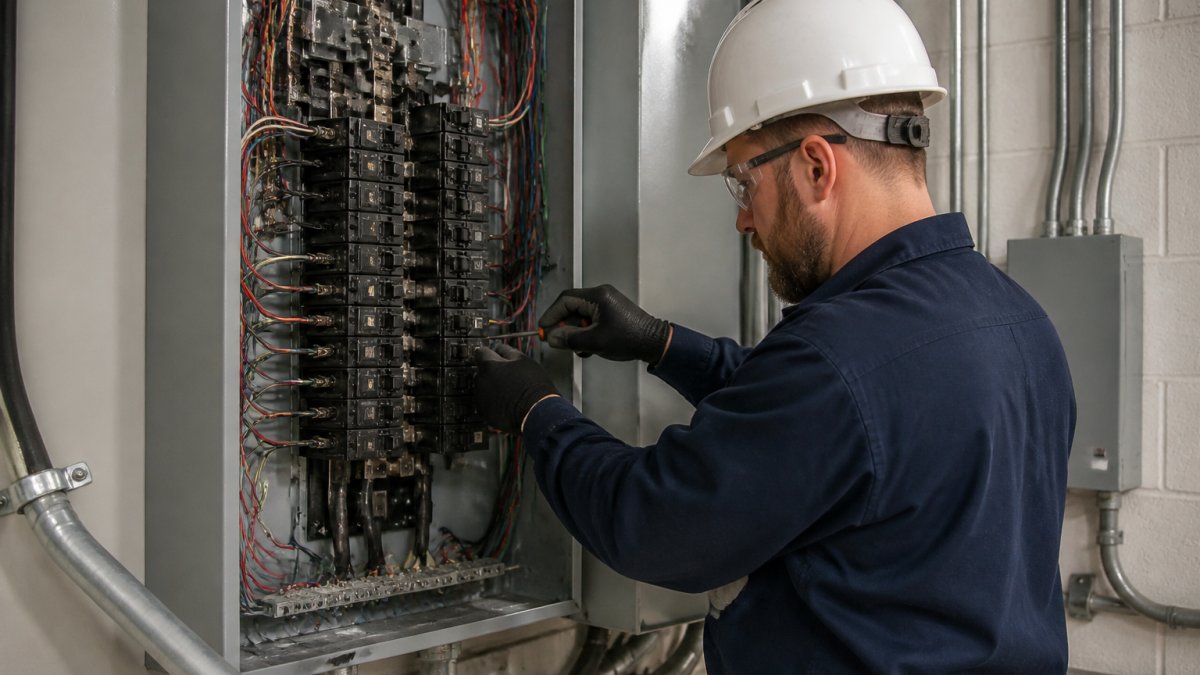
Table of Contents
- What Commercial Electrical Maintenance Includes
- Building a Preventive Electrical Maintenance Program
- Commercial Electrical Inspection Checklist and Frequency
- Electrical System Upgrades and Capacity Planning
- Emergency Repairs and System Reliability
- Compliance, Documentation, and Maintenance Contracts
- Measuring ROI and Budgeting for Electrical Maintenance
- Frequently Asked Questions
Last Updated: October 13, 2026
What Commercial Electrical Maintenance Includes
Commercial electrical maintenance keeps electrical systems operating safely and efficiently.
Preventive electrical maintenance differs from reactive repairs.
The scope covers inspections that identify code violations and safety risks; scheduled lighting maintenance, including motion sensors and photocells; panel upgrades and capacity planning; emergency repairs; and compliance documentation.
Looking for this work in Rutland or central Vermont? See commercial electrical wiring from Precision Power Services.
Treat commercial electrical maintenance as an investment, not an expense. Downtime costs far exceed preventive care, and failures damage reputation and trust.
Building a Preventive Electrical Maintenance Program
An effective preventive electrical maintenance program starts with knowing what systems you have, their age, and their operating demands.
Maintenance Planning by Building Type and Age
Different building types require different approaches.
Building age influences frequency and scope. Facilities built before 2000 often have outdated wiring, undersized panels, and corroded connections requiring more frequent inspection.
Operating hours matter too. A 24/7 facility stresses systems continuously and may need more frequent inspections than one running standard business hours. Heavy equipment accelerates wear on panels and connections, requiring more aggressive schedules.
Scheduling Inspections and Service Intervals
A maintenance schedule prevents emergencies from becoming crises. Most commercial facilities benefit from quarterly or semi-annual inspections, more frequent for older buildings or heavy equipment loads.
Between scheduled inspections, perform monthly visual checks for loose connections, burn marks, flickering lights, or unusual sounds. Documentation helps identify patterns and predict failures.
Specific components need individual schedules: generators require monthly testing and load exercises; backup batteries need quarterly capacity checks; lighting systems benefit from semi-annual photocell and motion sensor testing; breakers should be exercised annually to ensure proper tripping.
Commercial Electrical Inspection Checklist and Frequency
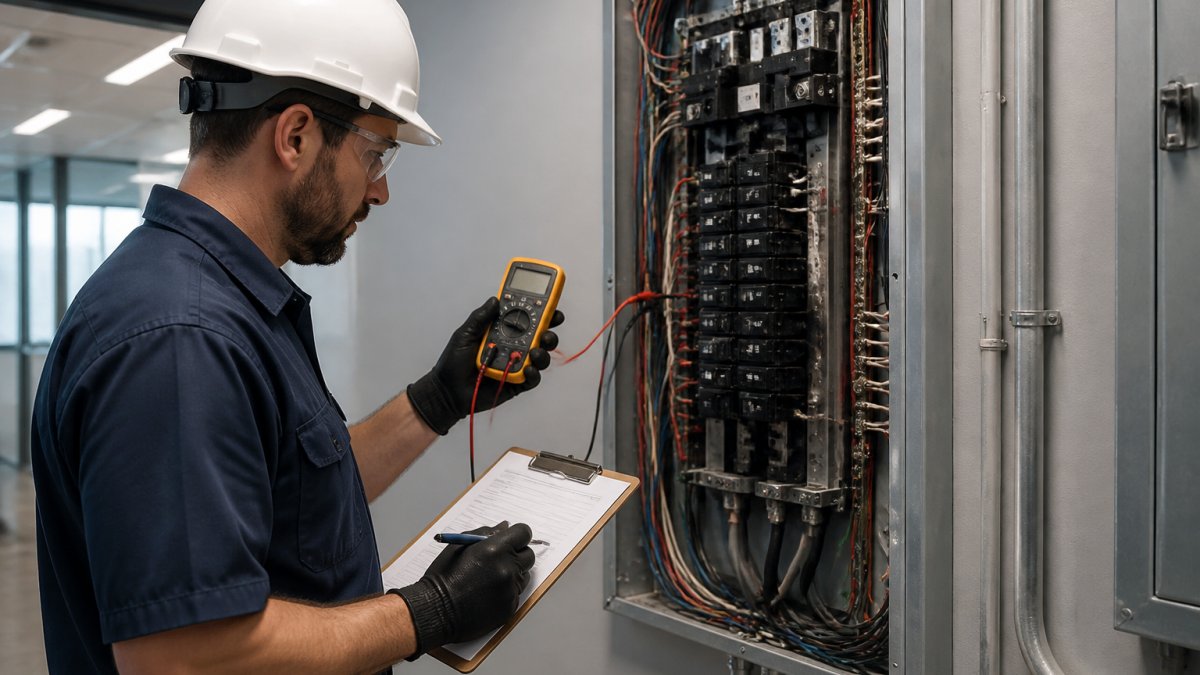
A systematic checklist ensures nothing gets overlooked. Organize tasks by frequency so facility managers can hand daily or monthly lists to on-site staff and reserve deeper work for a licensed electrician.
Daily and Weekly Tasks (On-Site Staff)
These visual, no-tools checks catch most developing problems before they become failures.
- Listen for buzzing, humming, or arcing sounds near panels and transformers
- Smell for burning or overheated insulation odors in electrical rooms
- Look for flickering, dimming, or discolored light fixtures
- Check that electrical room doors close, are labeled, and remain clear of storage
- Confirm no extension cords are used as permanent wiring
Monthly Tasks
- Visual panel inspection: open covers only if qualified; otherwise inspect through viewing windows for burn marks, corrosion, moisture, or loose debris
- Test ground-fault circuit interrupter (GFCI) receptacles using the built-in test button
- Exercise generator start sequence under no load and log the result
- Walk the exterior for damaged conduit, exposed wiring, or water intrusion into fixtures
- Confirm all panel and disconnect labeling remains legible
Quarterly Tasks
- Thermal imaging scan of panels, breakers, and major connections while under normal load, hot spots often appear months before failure
- Torque check on accessible lugs and terminations per manufacturer specifications
- Battery capacity check on uninterruptible power supply (UPS) and emergency lighting systems
- Test photocells and motion sensors on exterior and common-area lighting
- Inspect motor control centers and variable frequency drives for dust buildup and cooling fan operation
Semi-Annual Tasks
- Full lighting system audit, including fixture-level lamp and ballast or driver condition
- Test all emergency and egress lighting for the required duration
- Inspect all accessible junction boxes, wireways, and cable trays for damage or unauthorized modifications
- Review load readings against the previous period to spot growth trends
Annual Tasks
- Comprehensive inspection of the entire electrical system: service entrance, main switchgear, distribution panels, feeders, branch circuits, grounding, and bonding
- Exercise every circuit breaker to confirm it trips and resets properly
- Verify grounding electrode conductor and bonding jumpers are intact and tight
- Infrared survey of the service entrance under peak load
- Full generator or building load transfer test
- Arc-flash hazard analysis review and label verification
Frequency Modifiers
Inspection frequency depends on building age, usage, and criticality. Standard commercial facilities should conduct comprehensive inspections annually. Facilities with continuous equipment, older buildings, or major expansions may need semi-annual inspections. After significant electrical work, a post-completion inspection verifies code compliance and proper installation.
Documentation is critical. Each inspection should generate a report listing findings, hazards, recommended repairs, and timelines, demonstrating due diligence and supporting insurance claims.
Electrical System Upgrades and Capacity Planning
As businesses grow or add equipment, electrical demands increase. A 100-amp panel may become inadequate when adding heat pumps, EV chargers, or expanded HVAC capacity.
Assessing capacity requires understanding your electrical load. A qualified electrician calculates actual demand from equipment specifications, usage patterns, and simultaneous operation assumptions.
Panel upgrades typically involve a larger main service or a sub-panel to distribute loads more effectively.
Planning upgrades proactively costs less than emergency repairs and prevents disruptions.
Emergency Repairs and System Reliability
Despite preventive maintenance, unexpected failures happen. A lightning strike, equipment malfunction, or accidental damage can interrupt service suddenly, and response speed determines the business impact.
Emergency electrical repairs require immediate professional attention. Temporary fixes create safety hazards and may violate electrical codes.
Redundancy reduces downtime risk. Backup power keeps operations running during outages, dual circuits provide failover capability, and automated monitoring alerts managers before problems become emergencies.
Compliance, Documentation, and Maintenance Contracts
Electrical codes protect occupants and property, making compliance both a legal requirement and a practical necessity. The National Electrical Code (NEC), published by the National Fire Protection Association (NFPA), sets the baseline for installation and maintenance (Learn More About NFPA 70, National Electrical Code (NEC)). State and local jurisdictions adopt and amend the NEC on their own schedules, so the edition in force where your building sits may differ from the latest published version.
What Compliance Actually Requires
Compliance is not a one-time event. It is an ongoing obligation that shows up in three places:
- Installation compliance, new work, upgrades, and repairs must meet the adopted code edition at the time of permitting
- Maintenance compliance, ongoing maintenance must keep systems in safe operating condition; deferred maintenance can itself create a violation
- Documentation compliance, records must demonstrate that inspections, tests, and corrective work occurred
Common inspection triggers include annual fire inspections, insurance underwriter surveys, tenant build-outs, and change-of-occupancy reviews. Each may surface deficiencies that must be corrected on a defined timeline.
Building a Documentation System
A defensible maintenance record answers four questions for every asset: what was inspected, when, by whom, and what was done about any deficiency found. A practical structure includes:
- Asset register, a list of every major electrical asset (service entrance, main switchgear, distribution panels, transformers, generators, UPS units, motor control centers) with location, age, and nameplate data
- Inspection log, dated entries for each inspection with the checklist version used
- Deficiency log, every finding with severity, responsible party, target correction date, and closure evidence
- Test records, generator load tests, breaker exercise results, thermal imaging reports, and torque logs
- Compliance certificates, permits, inspection sign-offs, and any AHJ correspondence
Retain records for at least the life of the equipment where practical, and never less than your insurer or AHJ specifies. Digital records with timestamps and photo attachments are far easier to produce during an insurance claim or regulatory review than paper logs.
How to Evaluate a Maintenance Contract
A maintenance contract with a qualified provider establishes clear expectations and response times. It should specify inspection frequency, emergency response time, covered services, and pricing terms. Knowing what's included, and what costs extra, prevents surprises.
When comparing proposals, evaluate them on these dimensions:
- Coverage scope, which assets and systems are included? Are generators, UPS units, and switchgear covered, or only panels and lighting?
- Inspection frequency, how many scheduled visits per year, and does the schedule match your building's age and operating hours?
- Response-time commitments, distinguish between phone response, on-site response, and restoration. A one-hour phone response is not the same as a one-hour on-site arrival.
- After-hours and emergency rates, are nights, weekends, and holidays billed at a premium? Is there a cap?
- Parts and labor treatment, are common consumables (breakers, lamps, batteries) included or billed separately?
- Exclusions, what is explicitly not covered? Look for language excluding damage from power surges, water intrusion, or unauthorized modifications.
Service-level agreements (SLAs) define priority response. A contract guaranteeing one-hour response differs significantly from one allowing 24 hours. Matching the SLA to your business needs ensures appropriate coverage.
Matching the Contract to Your Facility
A single-site retail store and a multi-building campus do not need the same contract. Facilities with critical loads (data rooms, refrigeration, life-safety systems) should prioritize short response windows and generator coverage. Facilities with mostly lighting and receptacle loads can often accept longer response windows for lower cost. Review the contract annually against your incident history, if you pay for one-hour response but never use it, that premium may be better spent on additional preventive visits.
Measuring ROI and Budgeting for Electrical Maintenance
Calculating ROI for electrical maintenance reveals its business value: prevented downtime, extended equipment life, reduced emergency repair costs, and improved energy efficiency.
Downtime prevention provides the most dramatic ROI.
Extended equipment life is another measurable benefit.
Emergency repair costs dwarf preventive maintenance expenses.
Energy efficiency improvements reduce operating costs directly.
A practical budget allocates funds for scheduled maintenance, anticipated upgrades, and emergency contingency.
| Maintenance Element | Typical Frequency | Business Impact |
|---|---|---|
| Comprehensive inspection | Annually | Identifies hazards before failure |
| Circuit breaker testing | Annually | Ensures emergency shutoff function |
| Lighting system check | Semi-annually | Maintains efficiency and safety |
| Generator load test | Monthly | Verifies backup power reliability |
| Visual panel inspection | Quarterly | Catches corrosion and damage early |
| Thermal imaging scan | Every 2 years | Detects failing connections |
Commercial electrical maintenance for businesses isn't optional, it's essential to safe, reliable operations.
Commercial electrical work in Vermont
Commercial work in Vermont, including office fit-outs, retail spaces, and shop buildings, is held to the state-adopted code, so it pays to have a licensed electrician involved from the planning stage. Planning circuits, panel capacity, and future equipment up front is cheaper than adding them after the walls are closed.
Electrical work in Vermont follows the National Electrical Code as adopted in the Vermont Electrical Safety Rules (2025 edition, enforced by the Division of Fire Safety). Precision Power Services is a Vermont licensed electrician based at 450 Park Ln in Rutland, serving Rutland County and central Vermont.
Book a free estimate or call (802) 417-0587.
Frequently Asked Questions
What does commercial electrical maintenance include?
Commercial electrical maintenance covers routine inspections of panels and circuits, testing of safety systems, cleaning and tightening connections, replacing worn components, load testing, and documentation of all work. It includes preventive measures to catch hazards before they cause failures, emergency repairs when systems fail, and upgrades to handle increased power demand. A licensed electrician evaluates your specific system to determine what your facility needs.
How often should a business schedule electrical inspections?
Most commercial facilities benefit from annual inspections, though frequency depends on building age, usage patterns, and system complexity. Older buildings or those with heavy equipment loads may need semi-annual inspections. High-traffic retail or manufacturing spaces often require more frequent checks. A preventive electrical maintenance program tailored to your business type and operating hours will establish the right schedule to prevent unexpected downtime.
What should be included in a commercial electrical maintenance checklist?
A comprehensive commercial electrical maintenance checklist should include visual inspection of panels and wiring for damage, testing circuit breakers and safety switches, checking for loose connections, measuring voltage and load distribution, inspecting lighting systems and controls, testing emergency systems and backup generators, verifying grounding and bonding, and reviewing thermal imaging for hot spots. The checklist should be customized by system type, building age, and operational requirements, with all findings documented for compliance and future reference.
Why is preventive electrical maintenance important for businesses?
Preventive electrical maintenance reduces unexpected failures that cause operational downtime, protects employee safety, extends equipment lifespan, and helps your facility meet code compliance requirements. Regular inspections identify hazards like loose connections, overloaded circuits, and deteriorating insulation before they become dangerous or costly. Businesses that implement preventive programs typically experience fewer emergency repairs, lower energy costs, and improved system reliability.
How can I evaluate a maintenance contract or service agreement?
Compare contracts based on inspection frequency, response time for emergency calls, what repairs are included versus charged separately, whether documentation and compliance reporting are provided, and whether the contract scales with your facility's growth. Ask about the electrician's licensing and experience with your building type. Ensure the agreement specifies what happens during after-hours emergencies and whether priority service is available. Get clarity on pricing structure and any minimum commitments.
What are signs that a commercial electrical system needs maintenance?
Watch for flickering or dimming lights, frequent circuit breaker trips, buzzing sounds from panels or outlets, burning smells, warm outlets or switches, and visible corrosion on wiring or connections. Unexplained increases in energy costs, equipment that shuts down randomly, and aging panels (over 25 years old) are also red flags. Any of these signs warrant a professional commercial electrical inspection to prevent safety hazards and equipment failure.
Need an electrician in Rutland or central Vermont?
Precision Power Services is a licensed and insured electrical contractor serving Rutland, Killington, Brandon, Castleton, and surrounding towns. Call (802) 417-0587 or book online.
← Back to blog