Can Older Homes Support Heat Pumps? A Technical Guide
Table of Contents
- Can Older Homes Support Heat Pumps? The Short Answer
- Electrical Panel Upgrade for Heat Pump Installation
- Load Calculation for Older Homes: Sizing Your System Correctly
- Insulation and Heat Pump Efficiency: Why Building Envelope Matters
- Radiators, Underfloor Heating, and Compatibility Issues
- Hybrid Heat Pump Systems for Older Properties
- Key Takeaways for Retrofitting Older Homes
- Frequently Asked Questions
Last Updated: September 18, 2026
Can Older Homes Support Heat Pumps? The Short Answer
Yes, older homes can support heat pumps, but whether they can older homes support heat pumps depends on three critical factors: your electrical panel's capacity, your building's insulation levels, and your heating system's compatibility. Most homes built before 1990 need upgrades to handle a heat pump's electrical demands, and many require insulation improvements to maximize efficiency. The good news is that retrofitting older homes for heat pumps is entirely achievable with proper planning and professional assessment.
At Precision Power Services, we've worked with homeowners in central Vermont to evaluate whether their older properties can support heat pumps. The process isn't complicated, but it does require understanding your home's current infrastructure and what changes might be necessary. This guide walks you through the technical considerations that determine if your older home is a good candidate for heat pump installation.
Electrical Panel Upgrade for Heat Pump Installation
Heat pumps demand significantly more electrical capacity than traditional heating systems. A typical air source heat pump requires 30-60 amps of dedicated circuit capacity, depending on the unit's size and efficiency rating. Homes built before the 1980s often have 100-amp service panels, which may lack the available capacity for both existing loads and a new heat pump.
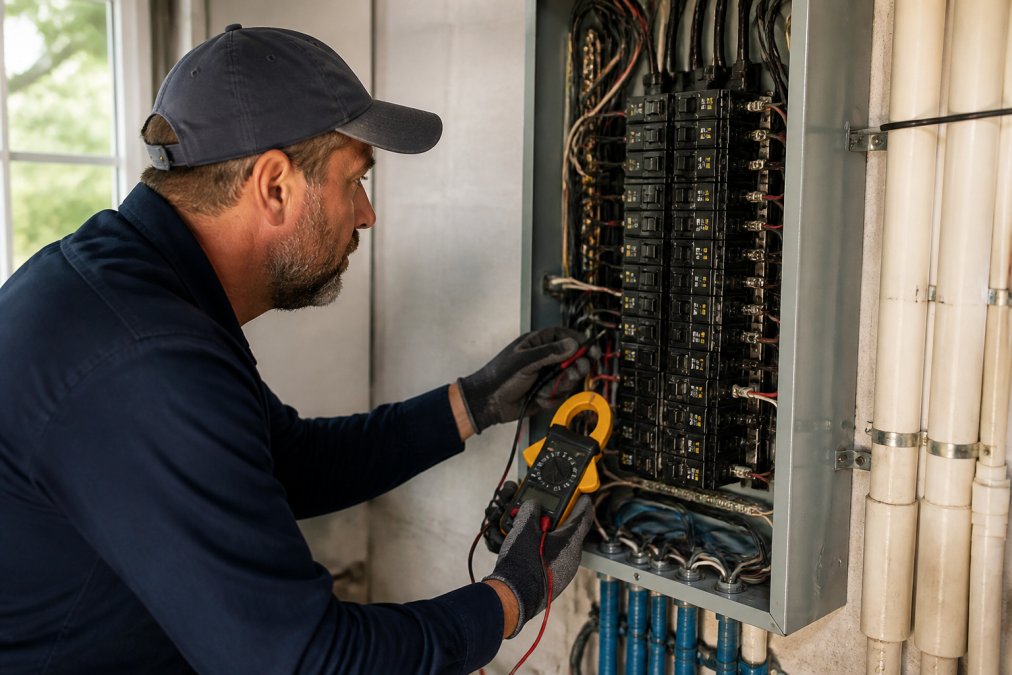
The first step in any heat pump retrofit is a load calculation. This determines how much total electrical capacity your home requires for all appliances, heating, and cooling combined. If your panel can't accommodate the heat pump without exceeding safe limits, you'll need a panel upgrade. Many older homes require upgrading from 100-amp to 150-amp or 200-amp service, which involves work at your meter and potentially coordination with your utility company.
Panel upgrades are a significant undertaking, but they're not uncommon in older homes adding modern electrical loads. The cost and complexity depend on your panel's current condition, the distance to your meter, and local electrical codes. This is where professional assessment becomes essential. An experienced electrician can determine whether your existing panel has spare capacity or whether an upgrade is necessary.
Load Calculation for Older Homes: Sizing Your System Correctly
A load calculation isn't just about fitting a heat pump into your electrical budget. It's about understanding your home's actual heating demand and selecting a system that matches it. Oversizing a heat pump wastes energy and money. Undersizing one leaves you cold and forces the backup heating system to run too often.
The calculation accounts for your home's square footage, insulation levels, window quality, air leakage, and local climate conditions. For older homes, this is particularly important because poor insulation and air sealing dramatically increase the heating load. A 2,000-square-foot home built in 1960 with minimal insulation might need a much larger heat pump than a similar-sized home built in 2000.
Many homeowners assume their old home needs a massive system. In reality, proper insulation upgrades often reduce the required heat pump size, which lowers both installation costs and operating expenses. A professional load calculation reveals these opportunities and prevents expensive oversizing mistakes.
Insulation and Heat Pump Efficiency: Why Building Envelope Matters
Heat pump efficiency depends directly on how well your home retains heat. A heat pump's coefficient of performance (COP) tells you how many units of heat it produces per unit of electricity consumed. In a poorly insulated home, the heat pump works harder to maintain temperature, reducing its efficiency and increasing energy costs.
Older homes typically have significant insulation gaps, but the specific gaps vary by architectural era and construction method. Understanding your home's age and style reveals where to prioritize upgrades:
Victorian and Edwardian homes (1880-1920): These typically feature solid masonry walls with no cavity for insulation. Attics often have minimal or no insulation. The rim joists and band boards around basement perimeters are almost always uninsulated. Upgrading attic insulation to 12-16 inches and sealing rim joists delivers the highest return on investment. External wall insulation is possible but expensive; many owners defer this until siding replacement is needed.
1950s-1970s ranch and split-level homes: These often have fiberglass batts in walls (R-3 to R-7 per inch), which have degraded over decades. Attics typically have 4-6 inches of insulation. Basement walls are often uninsulated concrete. These homes benefit most from attic top-ups to R-38 or R-49 (depending on climate zone) and basement rim joist sealing. Wall cavity insulation can sometimes be added via blown-in cellulose or spray foam without removing siding.
1980s-1990s homes: These usually have better baseline insulation (R-11 to R-13 walls, R-19 attics) but still fall short of modern standards. Air sealing around windows, doors, and penetrations often yields better returns than adding bulk insulation.
Concrete block and stone foundations (common in older homes): These conduct cold readily. Insulating the interior rim joist and band board is critical; insulating the foundation wall itself is often cost-prohibitive unless you're already finishing a basement.
A professional energy audit using thermal imaging or blower-door testing identifies your home's specific weak points. Many utilities offer rebates for these audits. Once you know where heat loss occurs, you can prioritize upgrades that maximize heat pump efficiency without overspending.
The strategic approach: combine moderate insulation improvements in high-impact areas (attic, rim joists, air sealing) with a properly sized heat pump. Most homeowners find that targeted insulation work, paired with a correctly sized heat pump, delivers excellent results and reasonable payback periods. The thermal efficiency gains compound over time, reducing your reliance on backup heating and lowering monthly energy bills.
Radiators, Underfloor Heating, and Compatibility Issues
Older homes typically use radiator-based heating systems designed to work with high-temperature water from oil or gas boilers. Heat pumps operate most efficiently at lower water temperatures, typically 35-50°C (95-122°F) compared to traditional systems' 60-80°C (140-176°F). This temperature mismatch creates a compatibility challenge, but it is not a barrier, it is a design consideration that requires assessment before installation.
Understanding the compatibility issue:
When a heat pump supplies water at 45°C instead of 70°C, each radiator emits less heat. A radiator sized for 70°C water may only deliver 60-70% of its original output at 45°C. For older homes with undersized radiators or poor insulation, this shortfall can be significant. The solution depends on your radiator system's condition and your home's heating demand.
Pre-installation radiator audit checklist:
-
Count and measure your radiators. Walk through each room and note the radiator dimensions (height × width in inches). Photograph each one. Larger radiators compensate better for lower water temperature; small decorative radiators in bathrooms or hallways may need replacement.
-
Check radiator condition. Feel the radiator surface while the heating system is running. Cold spots indicate internal corrosion or sludge buildup. Rust stains or leaks suggest the system needs flushing or repair before a heat pump is installed. A heat pump will not solve an already-failing radiator system.
-
Inspect the pipework. Trace the pipes from your boiler to radiators. Note whether pipes are insulated (they should be). Check for visible leaks, corrosion, or signs of repair patches. Older systems with multiple leaks or patches may need replacement or extensive flushing.
-
Identify your system type. Is it a two-pipe system (supply and return to each radiator) or a one-pipe series loop (radiators connected in sequence)? Two-pipe systems are more compatible with heat pumps because each radiator receives the same supply temperature. One-pipe systems are harder to balance at lower temperatures.
-
Assess your home's heating demand. On the coldest day of the year, does your current system keep all rooms comfortable, or do some rooms stay cold? If your boiler already struggles to heat your home on the coldest days, a heat pump operating at lower temperatures will face the same challenge. This signals that you may need radiator upgrades, additional radiators, or a hybrid system.
Compatibility solutions:
Hybrid Heat Pump Systems for Older Properties
A hybrid system pairs a heat pump with a backup heating source, typically a gas boiler or electric resistance heater. The heat pump handles most of the heating season when outdoor temperatures are moderate. The backup system engages during the coldest periods when the heat pump's output drops.
Key Takeaways for Retrofitting Older Homes
Retrofitting an older home for heat pump heating requires evaluating your electrical panel capacity, calculating your actual heating load, assessing your insulation performance, and determining radiator compatibility. None of these factors alone prevents heat pump installation. Together, they define the scope of work and help you choose between a full system replacement, a hybrid approach, or strategic upgrades that maximize efficiency.
Frequently Asked Questions
What electrical upgrades do older homes need to support heat pumps?
Most older homes require a 200-amp electrical panel to support a heat pump safely. If your panel is 100 amps or less, you'll need an electrical panel upgrade for heat pump installation. Your electrician will run a load calculation for older homes to determine exact requirements based on your system size, existing appliances, and any future additions like EV chargers. This assessment ensures your electrical system can handle the continuous power demand without overloading circuits.
Do I need to improve insulation before installing a heat pump in an older home?
Yes, insulation and heat pump efficiency are directly connected. Heat pumps work by moving existing heat, so they perform best in well-insulated homes. Air leaks, poor attic insulation, and drafty windows reduce system efficiency and increase energy costs. Before installation, have your home evaluated for air sealing and insulation gaps. Upgrading insulation first improves the heat pump's coefficient of performance (COP) and reduces the heating capacity you need, potentially lowering equipment and installation costs.
Can heat pumps work with old radiator systems in older homes?
Heat pumps can work with radiators, but they operate most efficiently at lower flow temperatures (around 35-45°C) compared to traditional boilers (55-65°C). Older radiator systems often require higher temperatures, reducing the heat pump's efficiency. You may need to install additional radiators, upgrade to underfloor heating, or use a hybrid system that combines the heat pump with your existing boiler for peak demand periods. Your installer will assess radiator sizing and heat emitter compatibility during the retrofit design phase.
What's the main downside of heat pumps in older, drafty houses?
The primary drawback is reduced efficiency. Heat pumps lose performance in homes with poor thermal envelopes, meaning you'll run the system longer to reach comfort levels, driving up energy bills. Drafty windows, uninsulated walls, and air leaks force the heat pump to work harder. Additionally, older homes may lack the electrical capacity or suitable heating distribution systems (like underfloor heating), requiring significant upgrades before installation. These retrofit costs can be substantial, though government incentives and long-term energy savings often justify the investment.
Need an electrician in Rutland or central Vermont?
Precision Power Services is a licensed and insured electrical contractor serving Rutland, Killington, Brandon, Castleton, and surrounding towns. Call (802) 417-0587 or book online.
← Back to blog