Custom Lighting Design for Modern Homes
Table of Contents
- What Custom Lighting Design Means for Your Home
- The Three Layers: Building Layered Lighting Design
- Modern Home Lighting Ideas by Room
- Smart Lighting for Modern Homes: Control and Efficiency
- Energy-Efficient Home Lighting: LED Performance and Operating Costs
- Planning Your Custom Lighting: A Step-by-Step Approach
- Common Mistakes in Custom Lighting Design
- Frequently Asked Questions
Last Updated: October 12, 2026
What Custom Lighting Design Means for Your Home
Custom lighting design is the process of planning and selecting fixtures specifically tailored to your home's layout, architecture, and lifestyle. It goes beyond picking lights off a shelf.
Looking for this work in Rutland or central Vermont? See outlet and switch repair from Precision Power Services.
At Precision Power Services, we help homeowners throughout central Vermont understand that good custom lighting design solves real problems. The difference between random fixtures and a thoughtful plan is the difference between a space that works and one that doesn't.
Modern homes benefit most from custom lighting design because they often have open floor plans, high ceilings, and large windows that change throughout the day. You need a plan that accounts for natural light, electrical capacity, and how you actually use each room.
The Three Layers: Building Layered Lighting Design
Layered lighting design combines three types of light to create depth, function, and mood. Most homes use only one or two layers, which is why they feel flat or too bright. Understanding these three layers is the foundation of any custom lighting design for modern homes.
Ambient Lighting: The Foundation
Ambient lighting provides overall illumination for a room. It's the baseline light that lets you see and move safely. Without it, you're working in shadows.
Ambient lighting typically comes from ceiling fixtures, recessed lights, or chandeliers. The goal is even coverage without harsh shadows. For a modern home, recessed lighting works well because it's clean and unobtrusive.
When planning ambient lighting, aim for brightness that matches the room's purpose. A kitchen needs more light than a bedroom. A living room sits somewhere in the middle.
Task Lighting: Function Where You Need It
Task lighting targets specific work areas. It's brighter than ambient light and directed at where you actually need to see clearly.
Common task lighting includes pendant lights over kitchen islands, desk lamps in home offices, and under-cabinet lighting in kitchens. These fixtures concentrate light where you're doing detailed work.
The key to good task lighting is placement. A pendant light should hang 30-36 inches above a countertop. A desk lamp should illuminate your work surface without creating glare on a screen.
Accent Lighting: Visual Interest and Depth
Accent lighting highlights architectural features, artwork, or plants. It adds dimension and draws the eye to what matters.
Wall sconces, picture lights, and spotlights serve as accent lighting. A sconce beside a mirror makes the bathroom feel spa-like. A light aimed at artwork makes it a focal point.
Accent lighting should be about three times brighter than ambient light to stand out. It's not about filling the room with light, it's about creating visual interest.
Modern Home Lighting Ideas by Room
Different rooms need different approaches. A kitchen demands bright, focused task lighting. A bedroom needs dimmers and softer ambient light. A living room balances all three layers to create flexibility.
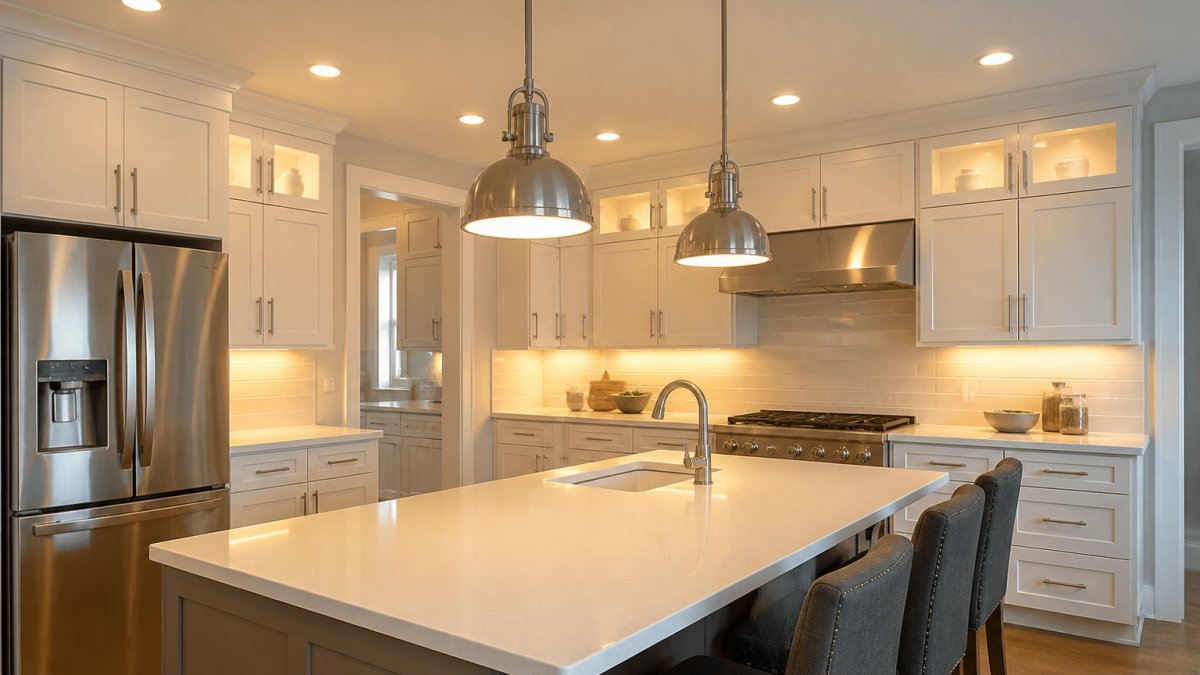
Kitchen Lighting: Brightness and Precision
Kitchens are work zones. You need bright, shadow-free light on countertops and the stove. Dim, moody lighting doesn't work here.
A strong kitchen lighting plan includes:
- Recessed ceiling lights for ambient illumination
- Pendant lights or track lighting over the island for task work
- Under-cabinet LED strips for countertop visibility
- A dimmer on ambient lights so you can adjust mood for dining
Under-cabinet lighting is often overlooked but makes a huge difference. It eliminates shadows when you're prepping food and looks clean in modern kitchens. LED strips are energy-efficient and easy to install if your electrical capacity allows.
Pendant lights over an island should hang 30-36 inches above the surface. Too high and they don't light the work area. Too low and they block sightlines across the kitchen.
Living Room and Dining: Ambiance with Control
Living rooms and dining rooms need flexibility. You might watch movies at night, host dinner parties, or read during the day. A single light switch doesn't cut it.
A layered approach works best:
- Dimmable ambient lighting from a chandelier or recessed lights
- Table lamps or wall sconces for softer evening light
- Accent lighting on artwork or architectural features
Dimmers are essential here. They let you adjust brightness to match the activity and time of day. A bright living room at 8 a.m. becomes intimate at 8 p.m. with the same fixtures.
Wall sconces flanking a fireplace or artwork add visual interest without cluttering the room. They're part of custom lighting design because they're intentional, not accidental.
Bedroom Lighting: Comfort and Dimming
Bedrooms need soft, dimmable light. Harsh overhead fixtures wake you up and make it hard to wind down.
A bedroom lighting plan should include:
- Dimmable ambient light from a chandelier or recessed fixtures
- Bedside table lamps for reading
- Wall sconces on either side of the bed for task light without overhead brightness
Dimmers on all bedroom lights are standard in good custom lighting design. You want to go from reading brightness to sleep-mode dimness without changing fixtures.
Avoid bright white light in bedrooms. Warmer color temperatures (2700K or lower) feel more relaxing and don't disrupt sleep patterns as much as cool white light.
Smart Lighting for Modern Homes: Control and Efficiency
Smart lighting lets you control brightness, color, and timing from your phone or voice command. It's part of modern custom lighting design because it adds flexibility without rewiring your home.
Smart bulbs fit into existing fixtures. Smart switches replace your current switches. Both give you dimming and scheduling without major electrical work.
Common smart lighting features include:
- Remote dimming from anywhere
- Scheduling lights to turn on/off at set times
- Voice control through Alexa or Google Home
- Scene creation (one button sets the whole room's mood)
- Energy monitoring to track usage
Smart lighting works best when paired with good fixture placement. A smart bulb in a poorly positioned light still won't solve the underlying design problem.
Energy-Efficient Home Lighting: LED Performance and Operating Costs
LED lights use 75% less energy than incandescent bulbs and last 25 times longer.
LEDs come in different color temperatures. Warm white (2700K) feels cozy. Neutral white (4000K) is bright and clean.
The operating cost difference is real. A single 60-watt incandescent bulb costs about $7-8 per year to run.
When planning custom lighting design, factor in long-term costs, not just upfront fixture prices.
Most modern homes can support LED fixtures without electrical upgrades. LEDs draw so little power that even older electrical systems handle them fine.
Planning Your Custom Lighting: A Step-by-Step Approach
Good custom lighting design follows a process. Skip steps and you end up with fixtures that don't work together or don't fit your space.
Step 1: Assess Your Space and Natural Light
Walk through your home at different times of day. Notice where natural light is strong and where shadows form. A south-facing room has different lighting needs than a north-facing one.
Ask yourself:
- Where does sunlight enter each room?
- Which areas stay dark even on bright days?
- How does light change from morning to evening?
- What's the room's primary use?
This assessment informs every decision that follows. A room flooded with natural light needs less ambient lighting. A north-facing room with little natural light needs brighter fixtures.
Step 2: Map Fixtures and Placement by Function
Sketch your room layout. Mark where you need task lighting (kitchen counters, desk, bedside). Mark where you want ambient light (ceiling, walls). Identify spots for accent lighting (artwork, architectural features).
For each fixture location, note:
- The type of light (recessed, pendant, sconce, lamp)
- The height it should hang or mount
- Whether it needs a dimmer
- The color temperature (warm, neutral, or cool white)
This map becomes your guide. It prevents the common mistake of buying fixtures without knowing where they'll go or how they'll work together.
Step 3: Choose Finishes and Scale for Your Design
Fixture style matters. A modern home with clean lines looks wrong with ornate brass chandeliers. A traditional home looks jarring with industrial steel pendants.
Consider:
- The finish (brushed nickel, matte black, brass, chrome)
- The size relative to the room (a massive chandelier overwhelms a small dining room)
- The shape (linear, geometric, organic)
- How fixtures coordinate with each other
Custom lighting design means fixtures work together visually, not just functionally. They should feel intentional, like they belong in your space.
Step 4: Verify Electrical Capacity and Code Compliance
Before installing anything, confirm your electrical panel can handle the new fixtures. Adding multiple recessed lights, pendants, and smart controls requires capacity planning.
Check:
- Total wattage of all new fixtures combined
- Available breaker space in your panel
- Whether existing wiring can support new locations
- Local electrical code requirements for fixture placement
This is where Precision Power Services adds real value. We verify your system can handle your custom lighting design before you buy fixtures. If you need panel upgrades or rewiring, we handle that work to code.
Common Mistakes in Custom Lighting Design
Understanding what goes wrong helps you avoid it.
Using only overhead lighting. A single ceiling fixture can't create the depth and flexibility that layered lighting does.
Forgetting dimmers. Dimmers transform a room by letting you adjust mood and brightness. Skipping them limits flexibility.
Mismatching fixture styles. A modern brushed nickel pendant next to a traditional brass sconce looks accidental.
Underestimating electrical needs. Assuming your current panel can handle new fixtures without verification leads to expensive surprises. Check capacity early.
Precision Power Services helps homeowners and businesses throughout central Vermont plan and install custom lighting systems that deliver both performance and aesthetics. From assessing your electrical capacity to handling code-compliant installation, we ensure your lighting design works as well as it looks.
| Step | Focus | Key Decisions |
|---|---|---|
| Assess | Natural light and room use | Sunlight patterns, primary activities |
| Map | Fixture types and placement | Heights, locations, dimming needs |
| Choose | Style and coordination | Finishes, scale, visual harmony |
| Verify | Electrical capacity and code | Panel availability, wiring reach, compliance |
Lighting upgrades in Vermont homes
Smart switches and dimmers often need a neutral wire in the switch box, which many older Vermont homes do not have. Check what is behind the switch before buying devices. For current lighting offers, see Efficiency Vermont.
Electrical work in Vermont follows the National Electrical Code as adopted in the Vermont Electrical Safety Rules (2025 edition, enforced by the Division of Fire Safety). Precision Power Services is a Vermont licensed electrician based at 450 Park Ln in Rutland, serving Rutland County and central Vermont.
Book a free estimate or call (802) 417-0587.
Frequently Asked Questions
What is custom lighting design for a home?
Custom lighting design creates a tailored plan for your home's illumination, combining ambient, task, and accent fixtures selected for your specific rooms, architectural style, and daily needs. Unlike standard installations, custom design accounts for natural light patterns, furniture layout, and your desired mood in each space. It ensures fixtures match your home's aesthetic while delivering proper brightness and function.
How do you plan layered lighting design effectively?
Layered lighting design combines three types: ambient light (overall room brightness from ceiling fixtures or recessed lights), task light (focused illumination for reading, cooking, or work), and accent light (highlighting architectural features or artwork). Start by identifying the primary activities in each room, then select fixtures for each layer. Dimming controls allow you to adjust brightness and create different scenes. This approach balances function with mood.
Can smart lighting work with custom-designed fixtures?
Yes. Smart lighting for modern homes integrates with custom fixtures through wireless controls, dimming systems, and voice commands. LED bulbs with smart capabilities fit most standard fixtures, and dimmer switches can be retrofitted to existing installations. Smart systems let you adjust color temperature, brightness, and scheduling across multiple rooms, enhancing both convenience and energy efficiency in a custom design.
How much does custom lighting design typically cost?
Pricing depends on the number of rooms, fixture types, smart controls, and whether electrical upgrades are needed. A consultation with a licensed electrician can assess your home's current capacity and provide an accurate quote. Energy-efficient LED fixtures and smart controls may have higher upfront costs but deliver lower operating expenses over time. Contact Precision Power Services for a personalized estimate based on your specific needs.
Need an electrician in Rutland or central Vermont?
Precision Power Services is a licensed and insured electrical contractor serving Rutland, Killington, Brandon, Castleton, and surrounding towns. Call (802) 417-0587 or book online.
← Back to blog